http://www.egyptembassy.us/
no comment...
Dec 1, 2005
Nov 30, 2005
Zewail, Frustrations of the Egyptian Nobel Laureate


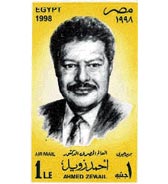 I've recently got Ahmad Zewail's biography (the Egyptian Nobel laureate for Chemistry '99). It's nice and has some interesting pictures.
Most interestingly, in the last 2 chapters he talks about his vision for enhancing the state of research in Egypt/Arab World and then US.
Apparently, after he got the Nobel prize and went to Egypt, he put the "corner stone" for University of Science and Technology (UST) and vision document for Technology Park (TP). In his bio, he stated 3 conditions for the success of this project:
1- Promise endowment (money from government & donations)The TP idea is cool. It aims to create a place where academia & industry can meet and do experiments & research related to the industry. I couldn't find any more info about the details - but it definitely sounds interesting.
2- Promise law that guarantee's full independence from the government
3- Curriculum (he will do it with advisors from around the world)
Zewail in his book cites several successful governmental research projects to excite the Egyptian government. These are the ones I remember:
1- The Max Planck institutions in Germany
2- The IITs & India Institute of Science in India
3- The Institute de France in France
4- The Technion and Wizeman institutes in Israel
5- U of California campuses in USA
6- ... there's one more. I can't remember.
Unsurprisingly, Egyptian government put the corner stone with names of 3 ministers & Mubarak, and never did anything else. Ahmad Zewail hints to that on page 223 his bio:
"I have had first-hand experience with UST and other projects in Egypt and have seen how bureaucracy and the 'power of the chair,' or more accurately the power of position, can impede real progress."And then finally on page 224
"Although clear orders regarding UST have been issued, the slow implementation of the plan is enough to subdue the enthusiasm of any serious person with obligations and exacting demands on his time."he also shows his frustration while collecting donations:
"Ironically, some of the very rich were less willing to make significant contributions until they had weighed their personal benefits."and then he goes on to say:
"The public sector was pushing me to begin a national donation campaign believing that every Egyptian should participate in this national cause. But of course, I could not do so without a new law that guarantees that UST will be able to function freely."RECENTLY I've heard that he gave up on Egypt government and went to Qatar to create his university. It seems that they have started building the university and that it's on its way. Also heard that he asked for "10 year grace period" after which results can be expected.
So, the question for you readers - Do you know anything about his project in Qatar? it sounds interesting. I looked on the internet, and I couldn't find anything more than 1-page biography for him and nothing about the University of Science and Technology.
Any more info on this guy?
Nov 29, 2005
First Concert!

 I love California, one for the sun, two for the mediterranean-like fruits & weather, and finally, for the active Muslim & Arab communities here!
I moved to the area 3 months ago, and quickly I found Aswat, a very impressive Arabic music community ensemble in San Francisco. I have joined as the most junior player on the Nay (which I've been playing for about 2 years). The group is very supportive and fun to be with. I played my first concert with Aswat at Mells College on Novermber 18th. Ah... I even got to do a short Taksim on Bayati.
Looking forward for weekends of Music.
Nov 26, 2005
Rome & Carthage: The Arrogance of “Democratic” Supremacy
In 149 BC, The Roman Senate took advantage of a minor disagreement with
Which begs the question, WHY!?
The decision was not that of momentous anger by a tyrant individual, for that
The decision was not that of military, for that even the famous Roman General that carried it out, Scipio Africanus, was against it. He followed the orders anyhow.
So, WHY!?
One cannot but think these days at the real value of democracy, try to understand the pros and cons beyond the usual clichés and banner-style statements like “democracy is the solution”. And to do so, there is nothing like learning the History of Rome, through which one can re-live Democracy on fast forward. There are many bright spots, and some deep bleak ones too.
I am not an expert in this field, but I have gone through
And this brings back us to the question, WHY!?
The answer is, because the Romans were the strongest nation at the time. They simply could do it, and so, they did it. “War Mongering” is the term.
This brings a second question: how come a group of highly educated Roman elected-senates come up with such an unjust and inhumane decision?
Simply, (and it took me a very long time to realize this answer) democracy does not guarantee making the right decision. Democracy guarantees agreement: that most of the attendants will agree on the decision. In another way, that the disagreeing portion will never be large enough to overrule the decision by power (or so is the theory).
Democracy is a lot like human-desire. It requires a high degree of discipline and dedication to actually be guided correctly. Democracy requires that we be active and objective all the time so that it won’t be misused. Democracy cannot function with a passive population.
Democracy is not ethical by itself. The ethics of democracy are that of its people. Democracy does not tell us right from wrong. But it can tell us what we ought to be doing about it. Things are not right or wrong just because 51% of people said so. Morality is independent of statistics.
Seems intuitive… but in the same time, it is very easy to forget this and fall in the same mistakes again and again…
Nov 25, 2005
A Jordanian wins Rhodes scholarship to Oxford
Tanya Haj-Hassan, a Jordanian American, wins the Rhodes Scholarship to Oxford.
http://www.cnn.com/2005/EDUCATION/11/20/rhodes.scholars.ap/
The Rhodes Scholarship is THE most prestigious scholarship available to undergraduate students in the US. Every year, each university nominates their top 2-3 students to apply. Only 32 are chosen every year. The scholarship pays for 2-3 years study at Oxford.
To put it in perspective, the Rhodes scholarship was what put Bill Clinton, a farm boy from Mena, Arkansas, on the path to US presidency.
I know Tanya personally, and she's my friend's cousin. She has lived and studied in Jordan until she moved to Stanford to study Human Biology. She's very humble and extremely active. I really hope best for her, and I hope more Jordanians will win this scholarship in the future.
The scholarship is available to citizens of about 22 countries. It'll be great if it becomes available to Jordanian citizens also one day. I'm not sure how we can make this happen.
more about the scholarship: http://www.rhodesscholar.org
notable winners: http://en.wikipedia.org/wiki/Rhodes_Scholarship
http://www.cnn.com/2005
The Rhodes Scholarship is THE most prestigious scholarship available to undergraduate students in the US. Every year, each university nominates their top 2-3 students to apply. Only 32 are chosen every year. The scholarship pays for 2-3 years study at Oxford.
To put it in perspective, the Rhodes scholarship was what put Bill Clinton, a farm boy from Mena, Arkansas, on the path to US presidency.
I know Tanya personally, and she's my friend's cousin. She has lived and studied in Jordan until she moved to Stanford to study Human Biology. She's very humble and extremely active. I really hope best for her, and I hope more Jordanians will win this scholarship in the future.
The scholarship is available to citizens of about 22 countries. It'll be great if it becomes available to Jordanian citizens also one day. I'm not sure how we can make this happen.
more about the scholarship: http://www.rhodesscholar.org
notable winners: http://en.wikipedia.org/wiki/Rhodes_Scholarship
Subscribe to:
Posts (Atom)